
If you care about how a watch looks after years on your wrist, ceramic cases should be on your radar. You get a surface that shrugs off scratches, keeps its color, and resists corrosion in a way steel and gold can’t match. Yet there’s a catch: ceramic’s brittleness changes how you wear it, service it, and even how brands design around it. That trade-off is exactly where the future gets interesting.
Modern ceramic watch cases are typically made from zirconium-oxide–based powders that are compacted in a mold and then fired at high temperatures. During firing, a process known as sintering fuses the particles into a dense, solid structure, with the component usually shrinking by around 20% as pores close and material consolidates. This manufacturing approach has become increasingly important in the watch industry, particularly for brands known for their use of advanced ceramic materials, such as Rado watches.
Once sintered, the case is very hard but also brittle, so it's shaped and finished using diamond tools and abrasives. This machining step defines precise edges, dimensions, and surface quality, whether the final finish is a high polish or a uniform matte. The scratch-resistant properties associated with ceramic cases are largely the result of this combination of material selection and precision finishing.
Because the material and process are unforgiving, small defects or dimensional deviations can render a part unusable. Manufacturers often plan for relatively high rejection rates, producing surplus cases (sometimes around 30%) to ensure that only components meeting strict quality standards are used. This attention to quality control helps explain why ceramic cases found in many premium timepieces, including certain Rado watches, require specialized production methods compared with traditional stainless-steel alternatives.
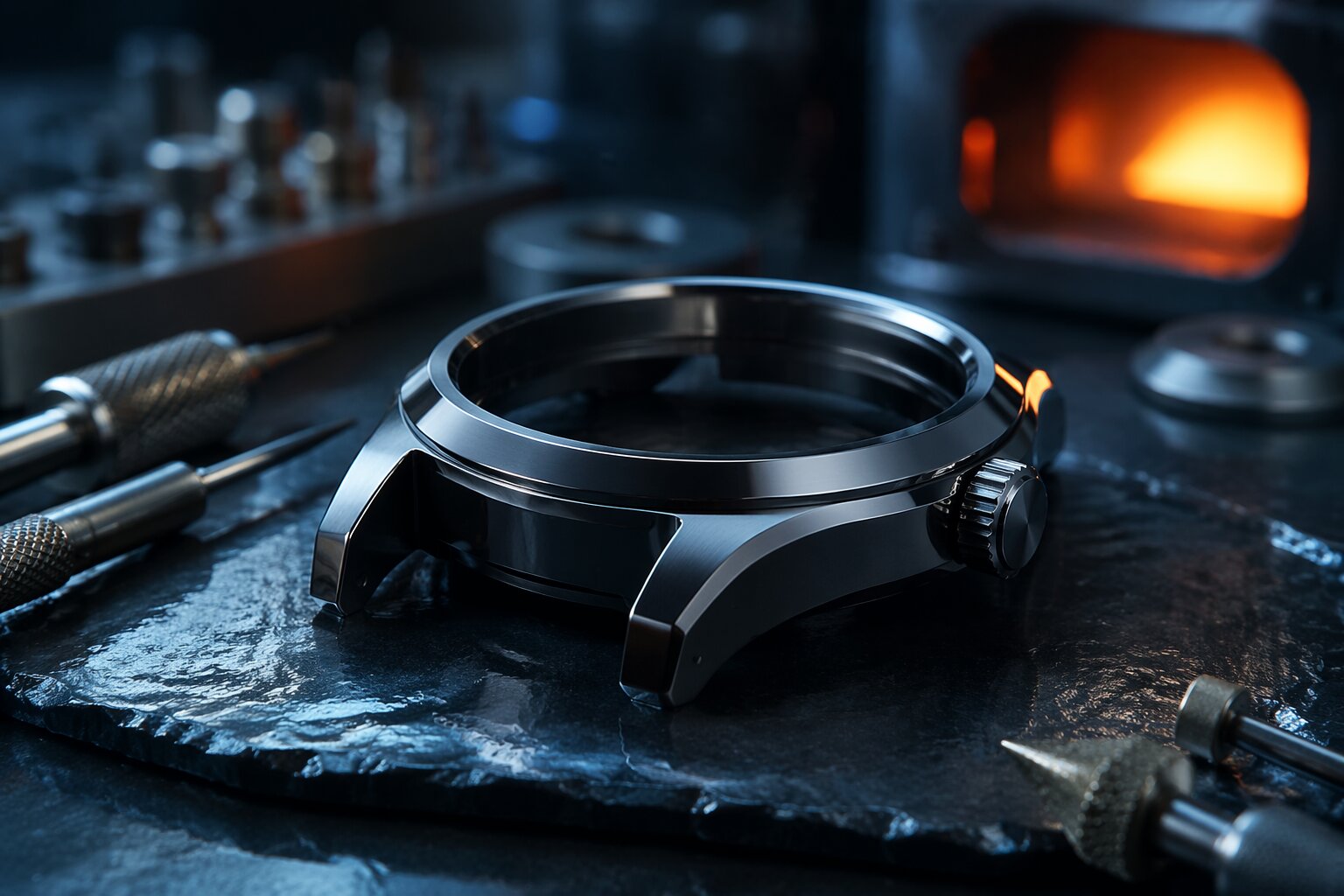
Understanding how a ceramic case is formed in a furnace helps explain its behavior on the wrist. The material, typically zirconium oxide, is very hard, so it resists scratches that would more easily mark steel or gold. As a result, the watch can maintain a sharp, glossy appearance over an extended period.
Ceramic is also relatively light and naturally hypoallergenic, which can improve comfort for some wearers, especially those with sensitive skin.
There are clear trade-offs. Ceramic is more likely to chip or crack under impact rather than dent, and the manufacturing process, pressing, sintering, and diamond polishing, is complex and costly. Damage often requires replacing the entire case instead of performing a simple repair.
In addition, because ceramic doesn't develop a patina, it lacks the gradual visual aging that some collectors value.
When comparing ceramic watch cases with traditional steel and gold for daily wear, several material characteristics stand out.
Ceramic is highly resistant to surface scratches, UV light, and corrosion, so it tends to maintain its original finish over time and usually requires little maintenance. It's also hypoallergenic, which can be beneficial for sensitive skin.
However, ceramic is more brittle than metals; while it resists scratching well, it's more susceptible to chipping or cracking if subjected to a strong impact.
Stainless steel is generally tougher in terms of impact resistance and can better withstand knocks and drops. It does scratch more easily than ceramic, but these marks can often be polished or refinished.
Steel is also relatively affordable and versatile in appearance and finishing.
Gold offers a distinct visual appearance, higher intrinsic material value, and a noticeable weight on the wrist. However, it's softer than both steel and ceramic, making it more prone to scratches and deformation, and it's substantially more expensive.
In daily use, this softness can lead to visible wear more quickly than with steel or ceramic.
Even in a tradition-oriented industry like Swiss watchmaking, brands are adopting ceramic cases because they address a practical, contemporary concern: maintaining a watch’s appearance over long-term, regular use. High‑tech zirconium oxide ceramics offer high scratch resistance and color stability, which helps a watch retain its original look even when worn frequently.
Ceramic watch cases also build on an established track record rather than being a recent experiment. Rado’s DiaStar and Ceramica were early examples that demonstrated ceramic could be used in premium watches. Chanel’s J12 helped bring ceramic more firmly into the mainstream luxury segment. Subsequent developments, such as Rolex’s Cerachrom bezels and Omega’s Dark Side of the Moon series, extended the use of ceramic to critical components and full cases.
These applications highlight characteristics such as low weight, hypoallergenic properties, and resistance to UV-induced discoloration. At the same time, they illustrate why ceramic watches often command higher prices, as producing and finishing ceramic components involves more complex and time‑consuming manufacturing processes than traditional metals.
Ceramic’s development from a niche experiment to a regular feature in luxury watchmaking does more than add another case material; it alters how a “modern” Swiss watch is defined. Buyers are no longer limited to steel and precious metals, but can choose cases designed to maintain color, edge definition, and surface uniformity over long periods of wear.
This shift affects how brands approach design, impact resistance, and after‑sales service, since a brittle ceramic case can't be refinished or repaired in the same way as steel.
Manufacturing challenges, such as high scrap rates, material shrinkage during sintering, and strict dimensional tolerances, tend to increase production costs.
At the same time, they encourage brands to place more emphasis on visible technical complexity and material engineering, rather than on the intrinsic value of gold or other traditional metals.
Ceramic watch cases let you wear your watch harder and longer, without babying it. You get crisp edges, stable color, and a finish that shrugs off scratches and corrosion in ways steel and gold can’t match. Yes, you’ll treat impacts with more care, but Swiss brands are already engineering around that. If you want a modern, durable, and truly “designed‑to‑last” luxury watch, you’re looking at the future, and it’s ceramic.